
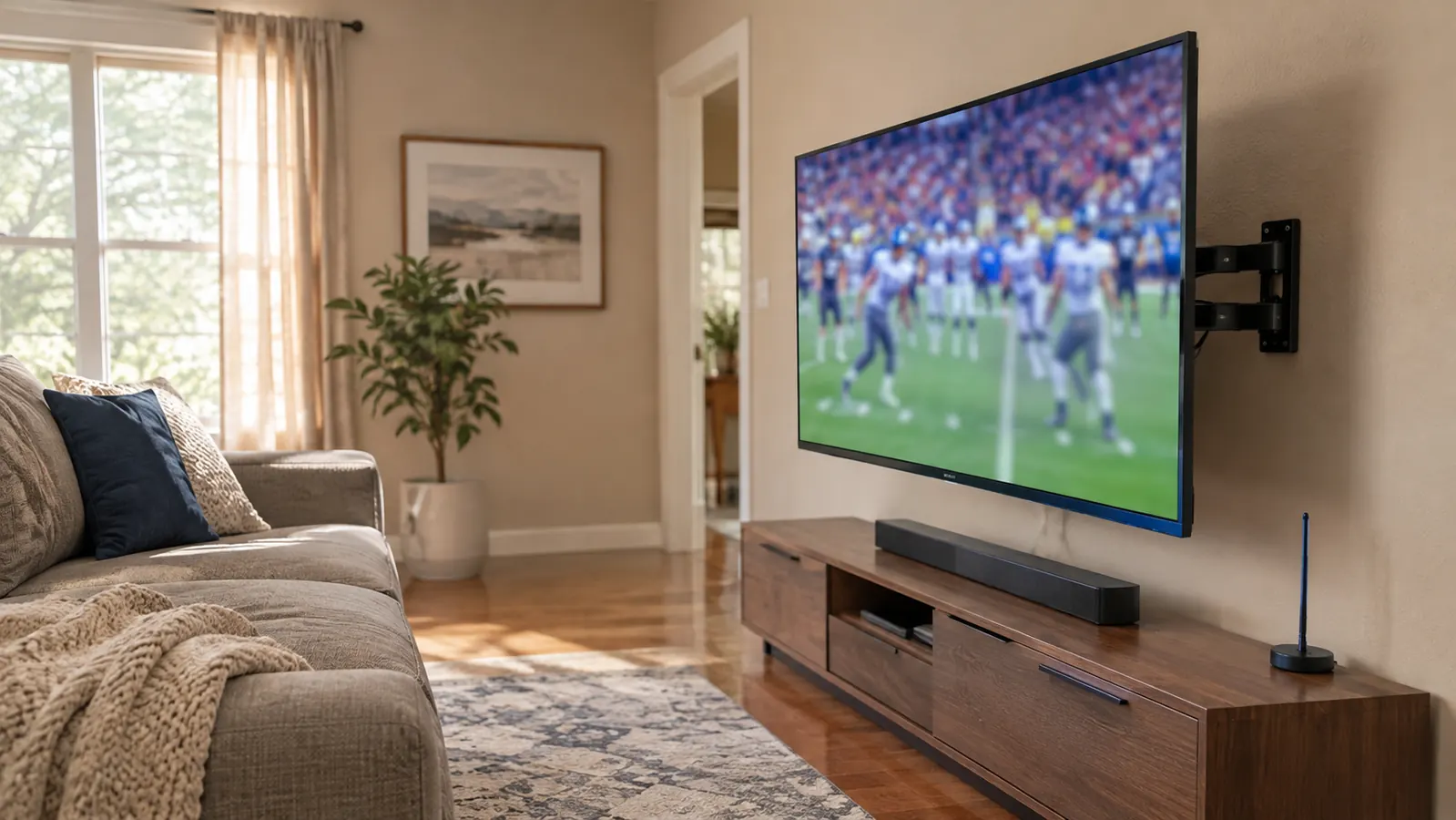
Short answer first, because that is the thing I went looking for and could not find a year ago: in my living room, the wall bracket won. The TV stand lost, but it lost on points. There are three rounds it takes clean, and if any of those three is your situation, you should stop reading about brackets and go buy a stand.
Here is the setup, so you can tell whether any of this applies to you. One living room, one TV that matters. In November 2025 I bolted a Mounting Dream Full Motion mount into two studs on the long wall, with my son Marcus on the other end of the set. The TV is a 55 inch TCL. The couch sits about 11 feet back. Gloria and I watch the morning news with coffee, the evening news at 6, college football on Saturdays, NFL on Sundays, and basketball all winter. The wooden stand the old 50 inch Samsung sat on has been in the garage since the morning we drilled. This is a year of living with both, not a spec sheet.
The Two Setups, Side by Side
| Mounting Dream Full Motion Mount | Wooden TV Stand | |
|---|---|---|
| Where the TV sits | Bolted to two wall studs on the long wall, up at sitting eye level, 11 feet from the couch. | On top of the stand, wherever the top of the stand happens to put it. |
| Changing the angle | Swivels left and right, tilts up 5 degrees and down 15, rides on six articulating arms and pulls out from the wall. | You set the angle once, when you set the TV down, and that is the angle. |
| Getting behind it to plug something in | Pull the arm out, reach around the back, push it flat again. | Crawl behind it, or lift the whole TV off and set it back down. |
| Installation | Drill, two studs, a level, and a second person to lift the TV onto the bracket. | Assemble with the hardware in the box, set the TV on top, done in an afternoon by one person. |
| What it does to your wall | Four bolt holes you will patch and paint if you ever move the TV. | Nothing. Not one hole. |
| Rearranging the room | Wherever the studs are, that is where the TV lives. | Slide it, turn it, put it on the other wall. |
| A home for the antenna and the soundbar | The bracket holds the TV and nothing else. Everything else needs furniture underneath. | Shelves are built into the same piece that is already holding the TV. |
| Cable clutter | Cables ride down the arm, then you still have to get them to the wall and down. Mine run in a plastic channel. | Cables drop straight down behind the stand and you never see them again. |
| A TV that gets bumped | Bolted into studs. The set is not going anywhere. | A stand is only as steady as its base, and a good shove moves the whole thing. |
| Best for | A room where you watch from more than one seat and want the screen higher than furniture puts it. | A rental, a wall with no usable studs, or someone who wants no holes in anything. |
Where Mounting Dream Wins
Height is the argument I did not expect to care about. A stand puts the screen wherever the top of the stand happens to be, which for furniture built to hold a television is lower than your eyes when you are sitting down. My old wooden stand measured about 22 inches to the top surface, and a 50 inch set sitting on that put the middle of the picture somewhere around knee to waist height. I never thought about it for years. Then one Saturday I caught myself leaning back with my chin up, trying to get level with the screen during a fourth quarter that would not end. On the wall the middle of the 55 inch TCL sits a shade over 40 inches off the floor, which is where my eyes land when I am on the couch with my back against the cushion. Same room, same couch, completely different posture. Gloria noticed before I said a word, because she stopped shifting around during the 6 o'clock news.
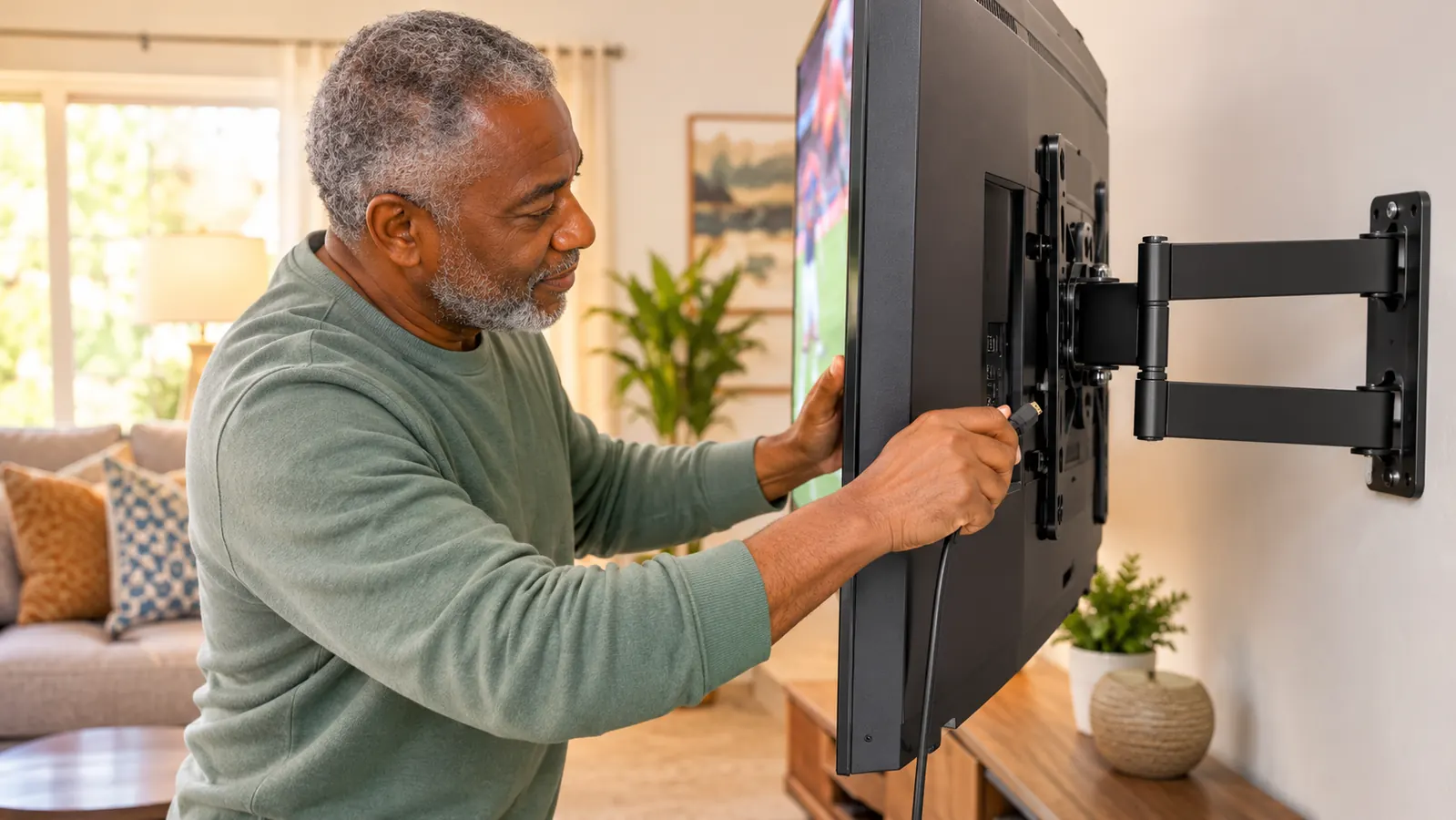
The second thing is movement. This bracket swivels left and right, tilts up 5 degrees and down 15, and rides on six articulating arms, so it pulls out from the wall and goes back flat when you push it. Gloria watches the 6 o'clock news while she is cooking, and I pull the TV out and swing it toward the kitchen side so she can see the screen from the stove. Sunday, it goes back flat and the room looks like a room again instead of a sports bar. There is also a plus or minus 3 degree adjustment after the thing is hanging, which sounds like a small detail until you are the one holding a level against a 55 inch screen and discovering your wall is not as straight as you assumed.
The last one is smaller but real. The stand took up a footprint on the floor, the TV sat on it, and every other box crowded around the base. With the set on the wall, the floor under it belongs to the console and nothing else, and the room reads wider than it did. Marcus noticed before I did, the first Sunday he came over after we hung it. He sat down, looked up, and said the room felt bigger. He was right. It did.
Where the TV Stand Wins
Install day is where the stand wins and it is not close. I spent my working life under city buses, so a drill does not scare me, but this still ate a morning. First try, my old magnetic stud finder kept singing at a spot that turned out to be a copper pipe, so I backed off, found the two studs by tapping and measuring from the corner instead, and marked a line with painter's tape. The hardware came in pre-labeled bags, which saved me from emptying a hundred little pieces onto the rug and sorting them by eye. Marcus held the bracket level against the tape while I drove the bolts into the studs, then the two of us lifted the TCL onto the arms. Start to finish, close to three hours with a coffee break in the middle. A stand takes one person a Saturday afternoon with a screwdriver and no arithmetic at all. If your weekend is worth more to you than the difference in the picture, take the stand and be done.
Then there are the holes. Four of them, in a wall, and if that TV ever comes down I will be patching and painting. A stand leaves nothing behind. The studs also get a vote on your furniture arrangement, which is a strange thing to hand over to a piece of wood behind drywall. If you rent, or if you like moving the couch twice a year, the stand is the honest answer and no bracket is going to change that.
One more thing for the stand, because it earned it. A stand is furniture. It holds the TV and it holds the rest of the gear in the same piece, so that is one thing to buy and one thing to dust. Mine had two shelves and they were full for years: cable box on the top one, a DVD player and a stack of discs below it. When we cancelled cable in April 2025 most of that went away, and what was left, the Roku stick and the indoor antenna, ended up on the low console under the TV anyway. A wall bracket is a bracket. It holds the TV and nothing else, and everything that used to live on the stand needs a home somewhere. If your gear situation is already crowded, the stand solves two problems at once and the bracket solves one.
Two studs and one long wall is all this needs
The Mounting Dream Full Motion mount fits 32 to 70 inch TVs up to 110 pounds, tilts down 15 degrees to knock the afternoon glare off the screen, and swings out so you can reach the ports without lifting anything. Mine has been on the wall since November 2025.
Amazon Check Today's Price on Amazon →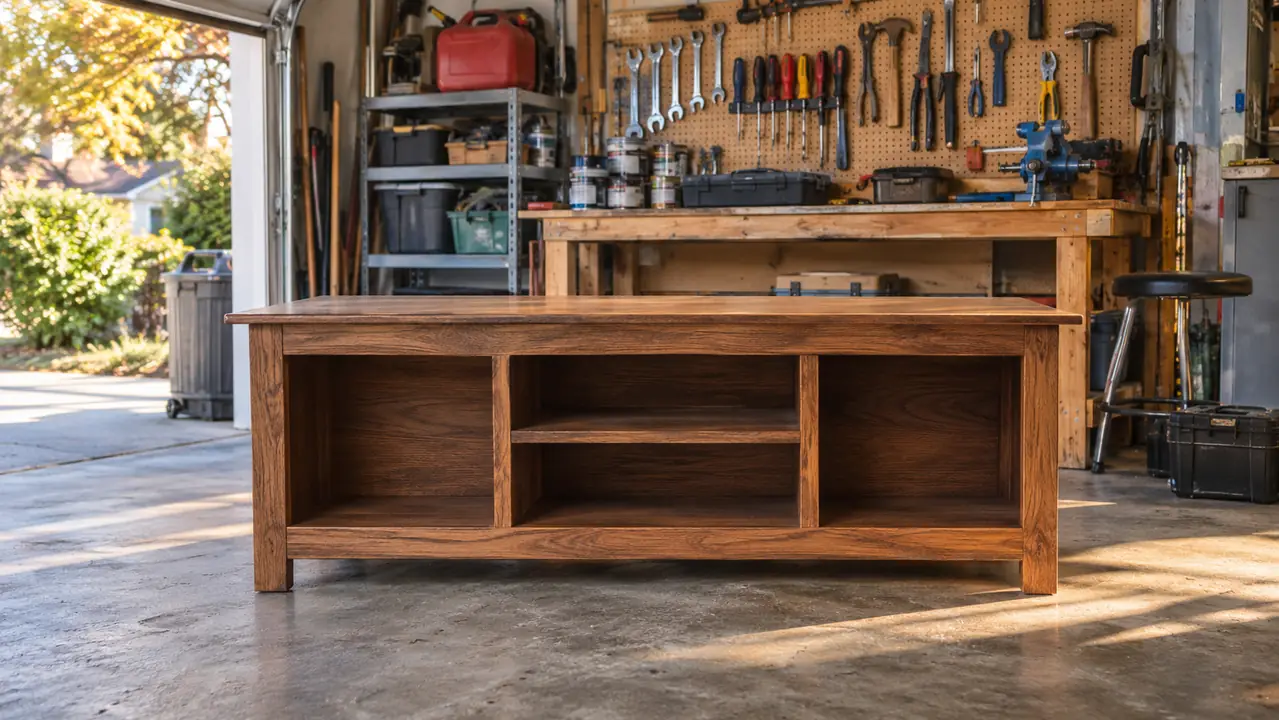
What Neither One Fixes
Neither the bracket nor the stand does a thing for the picture itself. When I moved from the old 60Hz Samsung to the TCL before Thanksgiving football, that is what changed how a kickoff return looks. On the old set a punt would leave a faint trail behind the ball, and I had assumed for years that was just how football looked on television. It was not. The new panel cleaned that up in the first quarter of the first game I watched on it. Fast motion is the panel's job. If the ball smears across the screen on a punt, no bracket on earth is going to help, and I would rather you hear that from me now than spend the money and blame the wall. I have watched a full season since, and nothing about hanging the set higher made a single frame clearer.
Same story with dialogue. Gloria could not hear the evening news through the thin TV's own speakers, and hanging the set on the wall did not change that by a decibel. For a couple of months she had the volume up around 40 for the 6 o'clock news and still asked me to repeat what the anchor said, which is a strange thing to be asked about a man on television. What fixed it was the Polk Audio Signa S2 soundbar on the console underneath, one HDMI cable into the ARC port. She has not asked me once since. The bracket holds the TV up. It does not make the TV louder, sharper, or smarter, and anyone who tells you otherwise is selling something.
Cables are on you either way. The arms give you somewhere to run them down, but eventually they have to get from the back of the TV to the wall and then down to the console, and mine go through a plastic channel I stuck to the drywall. The indoor antenna still has to stand upright somewhere near the window, which in this house means the low console. Putting a TV on the wall does not remove a single box from your life. It just moves the box.
The bracket did not improve one pixel. What it did was put the picture where my eyes already were, and that turned out to matter every night of the week.
What I'd Check Before You Drill
Find the studs before you buy anything. Not with a magnet and a hopeful guess. Two studs, in the place where the TV is actually going, not the place where it is convenient. I marked mine after measuring from the corner and tapping along the drywall until the sound went dull, then confirmed with a thin nail before I committed a drill bit to anything. Then set the height with a tape measure and a person sitting on the couch, not standing in the middle of the room looking pleased with himself. Gloria sat where she always sits and I held a piece of cardboard at the height I was considering, and we moved it twice before I was satisfied. Sitting eye level is the entire point, and it is very easy to hang the thing four inches too high because it looked fine from the doorway. Also look at what is behind the set: an outlet, a cable plate, or the top of the console can all land exactly where an arm wants to swing.
Check the weight and the back of your TV. This bracket is rated for 32 to 70 inch sets up to 110 pounds, with a max VESA of 400 by 400, and the 55 inch TCL sits comfortably inside that. If your set is heavier than the rating, stop, do not improvise. And plan for a second pair of hands on lift day. I do not care how strong you were at 30, a 55 inch screen is an awkward shape and it wants two people.
Who Should Buy Which
Buy the Mounting Dream Full Motion mount if you watch from more than one seat, if the couch is 10 or 11 feet back and the screen needs to sit higher than the furniture puts it, if you have two usable studs where the TV belongs, and if you are staying in that house for a while. Sunday football is the test in this house: Marcus takes the end of the couch nearest the window and I take my chair, and neither of us has ever asked the other to move. It also earns its keep when someone in the household watches while doing something else in the next room, because a screen that swings is the only way that works. That is the whole reason the kitchen angle exists here.
Buy the stand if you rent, if you cannot find two studs, if you rearrange the furniture, or if you want the TV to arrive and be finished in one afternoon with no patching afterward. There is no shame in it. My old wooden stand held a 50 inch Samsung for years and never once complained. It just could not put the screen where my eyes were, and that is the only reason it is in the garage now instead of under the TV.
If the wall is yours and the studs are there, this is the one I'd hang again
Six articulating arms, 15 degrees of downward tilt for glare, a plus or minus 3 degree adjustment after hanging, and a lifetime warranty. Rated for 32 to 70 inch TVs up to 110 pounds.
Amazon Check Today's Price on Amazon →