
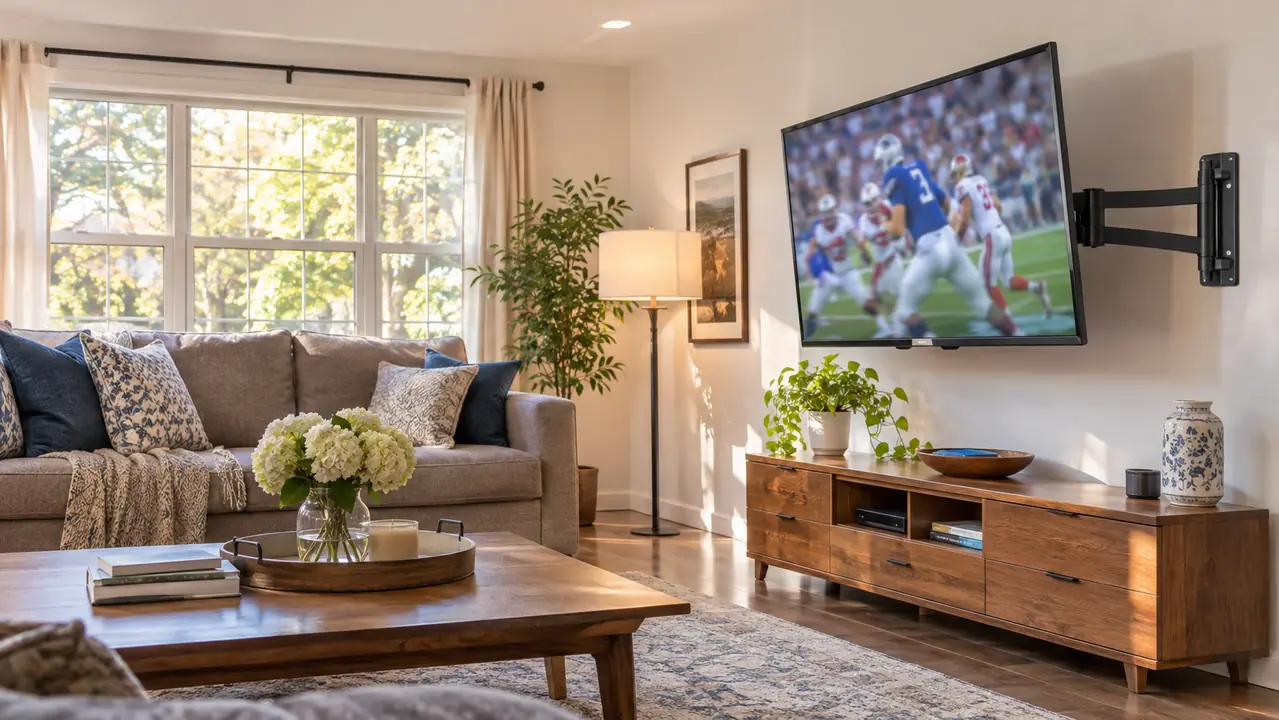
The first Saturday after the TCL went up on the wall, I sat down with a bowl of peanuts and watched an entire first quarter without once thinking about the television. That had not happened in nine years. Before this, the set sat on a wooden stand that was a few degrees off level because the floor in this old Raleigh house is a few degrees off level, and every kickoff came with a faint smear trailing the ball that I had quietly learned to live with. I did not know I was living with it until it stopped. The Mounting Dream Full Motion mount is the reason.
I am Curtis Mabry. I spent 31 years fixing city buses, I am 58 now, and I bought this Mounting Dream bracket the same week in November 2025 that I bought the 55 inch TCL T7, a few days before Thanksgiving football. I put it into two wall studs on the long living room wall myself, with my son Marcus doing the lifting when it came time to hang the set. This is not a spec sheet read back to you. It is what one full motion bracket has and has not done in a living room where a single television handles the morning news, the six o'clock news, Saturday college football, Sunday NFL, winter basketball and the odd summer baseball game.
The Quick Verdict
Six articulating arms, fifteen degrees of downward tilt and a swivel I use twice a day. It has held a 55 inch set for a year without a creak or a drift. The only thing I gave up was a flush fit against the wall.
Amazon Check Today's Price →The bracket that got my 55 inch set off a crooked wooden stand
Two studs, six articulating arms, and a picture that finally points at the couch instead of past it. Same one I hung in November.
Amazon Check Today's Price on Amazon →How I've Used It
Here is the layout, because it explains every choice I made. One living room. The television hangs on the long wall and the couch sits about eleven feet back from it. The kitchen is off to the right through a wide doorway, which matters more than I expected. Under the set is a low media console that holds the antenna on the window side and the soundbar in the middle. Gloria watches the six o'clock news while she is putting dinner together, and before the bracket she was leaning out from that doorway every ninety seconds to see around the wall. Now I pull the set out and swing it toward the kitchen side and she can see it while she works. When we actually sit down to watch something, I push it back flat.
What I did not expect is how much of the improvement came from the set being square to the couch. On the old wooden stand, the TV was turned slightly to compensate for the stand being slightly out of square, so the face of the screen sat a handful of degrees off from my eye line. You would not think that matters. It does. The score graphic at the bottom of the screen looked a half step soft, and I spent years assuming the panel was the problem. It was the angle. The Mounting Dream bracket fixed the angle. That is honestly the whole story of why I like this thing. The panel did not get better. It got pointed at me.
The swivel gets used more than any other part of it. Morning coffee and the local news, I leave the set flat. Evening news, out it comes. Sunday, flat again, because Marcus and I are both on the couch and neither of us wants the picture aimed anywhere but straight ahead. Over a year of that, twice a day, the arms have not gone loose and the set has not drifted out of level. I check it about once a month with the same two foot level I used on install day, out of habit more than suspicion.
The arms give you something the listing does not sell you on, which is room to work. When I need to get at the back of the set, I pull it out and there is space behind the panel to reach the ports. The power cord and the antenna cable both run down from there, and when I added the soundbar in January I did not have to lift the television off the wall to get an HDMI cable into the ARC port. On the old wooden stand that would have been twenty minutes of feeling around blind with a flashlight.
Glare was the other thing. The window is on the same side as the antenna, and the morning sun comes in low and hits the screen at an angle that turned the local news into a mirror for about forty minutes a day. The downward tilt handles that. Fifteen degrees down is more than I thought I needed, and I ended up using most of it in winter when the sun sits lower. The upward five degrees I have used exactly once, to get my hand behind the set for a cable, and I do not expect to use it again.
What the Six Articulating Arms Actually Do
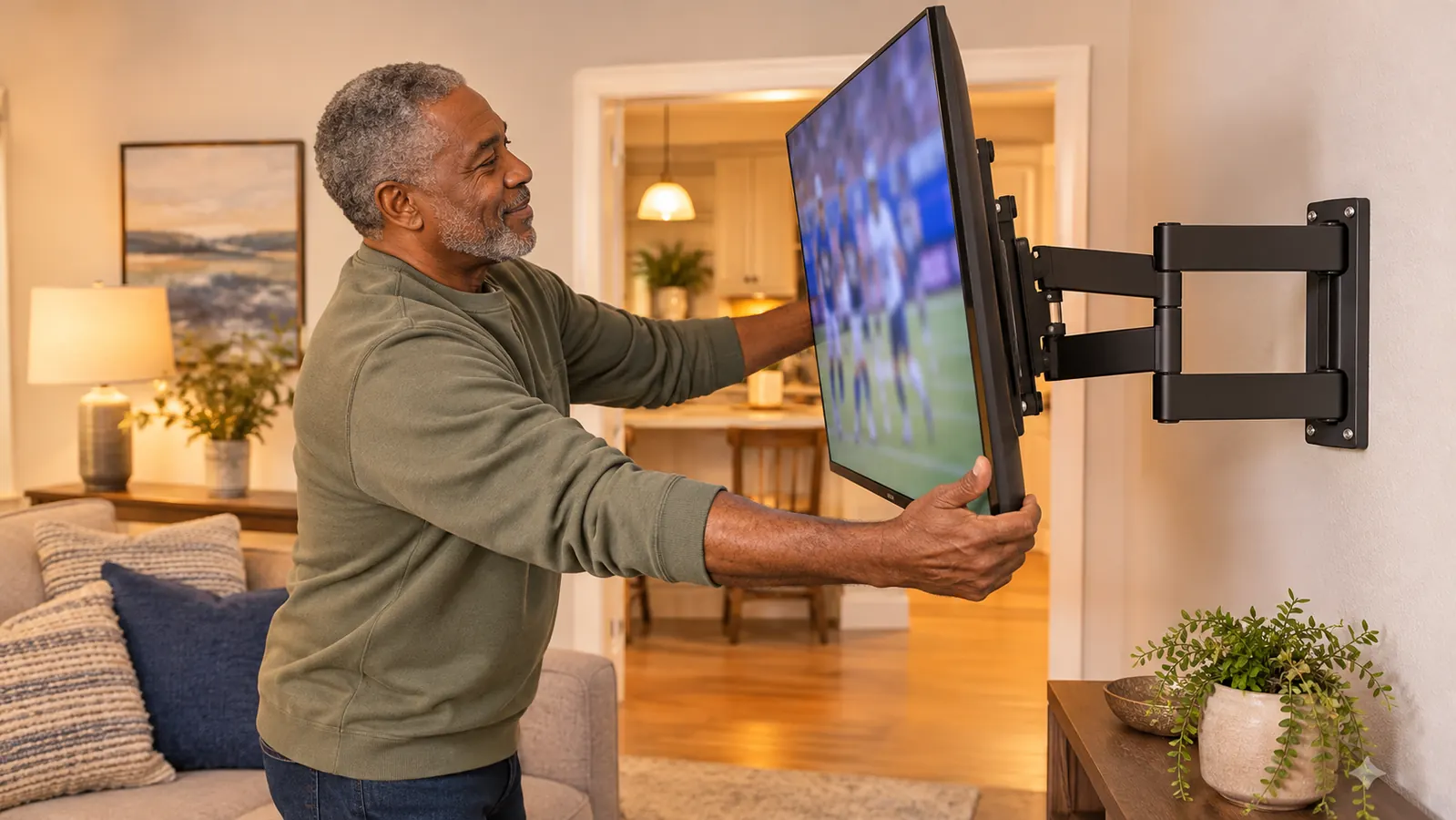
Six articulating arms is the part of the listing that sounds like marketing and is not. Two vertical rails bolt to the back of the television through the four bolt holes that match its VESA pattern, and this bracket takes up to 400 millimeters by 400. The arms are what let those rails travel out from the wall and rotate once they are out. More arms means the weight is spread across more hinge points instead of hanging off one. The rating is 110 pounds and a screen anywhere from 32 to 70 inches. My 55 inch TCL sits nowhere near the ceiling of that, which is exactly how I like a bracket holding a television over a couch where my wife sits.
Before I ordered, I took the tape measure to the back of the TCL and measured the spacing between those four bolt holes, then checked it against what the bracket lists, a maximum of 400 millimeters by 400. If your set falls inside that and weighs under 110 pounds, you are covered. It is the one number worth checking twice, because a bracket that does not match your hole pattern is a bracket you cannot use, and no amount of adjusting fixes it. Mine lined up on the first try, which was a relief after two evenings of reading listings.
The tilt and the swivel are hand powered, and I want to be plain about that because I have read listings that left it fuzzy. There is no motor, no remote, no app. You walk up and you move it. The tilt goes five degrees up and fifteen degrees down. The swivel goes left and right by hand and stays where you leave it. There is also a small amount of adjustment built in for squaring the set up after the wall plate is already bolted on, plus or minus three degrees, which is the feature I did not know I needed and would now not buy a bracket without.
The build is metal throughout and it feels like it. I am not a small man, and I hung off the Mounting Dream wall plate with both hands before I let Marcus bring the television anywhere near it. It did not flex. What it is not is invisible. A full motion bracket holds the set out from the wall on arms, so there is a gap behind the television and you can see the arms from the side of the room. If you want the set to look like it grew out of the drywall, this is the wrong kind of bracket and no amount of adjusting will change that.
Game Day Versus the Evening News
Two people watch two different things in this house and the bracket serves both. Gloria wants the six o'clock news and she wants to hear it. Aiming it toward the kitchen solved the seeing. The hearing was a separate problem and I will not pretend otherwise: the thin speakers in the new set were the weak link, and the Polk Signa S2 we added in January 2026 is what actually fixed dialogue. What the bracket did was get the picture out of the glare and pointed where she actually stands, so she stopped leaning out from the doorway. She noticed that inside a week. She has not mentioned the bracket since, which from her is high praise.
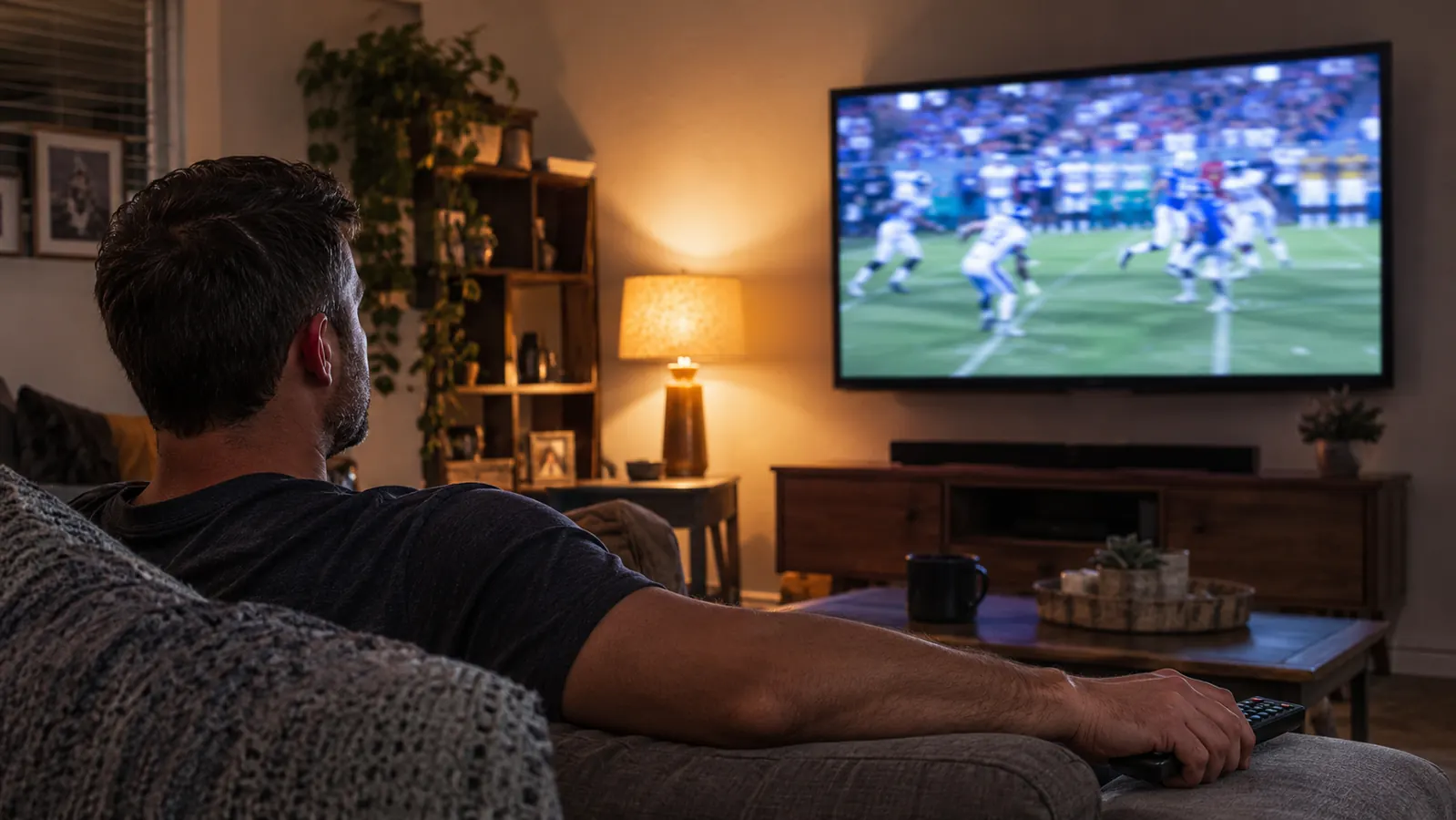
For football the difference is smaller but real. A kickoff return is the hardest thing a television has to draw, and the TCL does the heavy lifting there. The bracket's contribution is that the picture is square to the couch, so the whole panel sits at the same distance from my eye instead of one end being closer than the other. The score bug in the corner reads clean. The ticker along the bottom does not run at a slant. Those are small things that add up over three hours, and I noticed all of them in the first game and none of them since, which is the correct outcome for a piece of hardware.
The second Saturday in October is the example I keep coming back to. I had a college game on and Marcus was due over early. I had swung the set toward the kitchen the night before so Gloria could watch the news while she cooked, and I did not push it back square before kickoff. Ten minutes in, the ticker along the bottom of the screen ran downhill to the right. That was not the broadcast and it was not the panel. It was me. I walked up, pushed it flat, and the rest of the game was straight.
Basketball in winter is where the swivel earns its keep again. Marcus sits at the far end of the couch, which used to mean he got the worst seat in the house. Now I nudge the set a few degrees toward his end when it is just the two of us and the game is on. That is the entire feature set in practice. Aim it at whoever is watching.
The Install, and the One Thing I'd Change
I put it up on a Saturday in November 2025. Two studs on the long wall, found with a stud finder and confirmed with a thin nail, because I do not trust a stud finder on old plaster. The hardware came in pre-labeled bags along with the instructions, which sounds like a small thing until you have spent twenty minutes sorting bolts on a kitchen table. The wall plate went up, the rails went on the back of the television, and then Marcus and I lifted the set onto the arms together. That last part is not optional at 55 inches. Do not try it alone.
I made one pencil mark at what I thought was the right height, stood back, and decided it was three inches low, because I had measured from the floor instead of from the top of the media console. The console has a slight lip and I had not accounted for it. The good news is that I caught it with a pencil mark and not with a drill bit. Get a second set of eyes on the mark before the drill comes out, and measure from where the set will actually sit rather than from the floor.
The one thing I would change is the order I did the leveling. I had the set on the wall and the bolts snugged down before I checked it, then had to back them off and use the built in adjustment to bring it square. Read that part of the instructions first. If I were doing it again I would also measure from the wall to the front of the set before I picked the height, because a full motion bracket needs more room behind the television than a flat one does, and I got lucky that my wall plate cleared the media console underneath.
A year in, the arms hold their position, the level has not moved, and there is no creak when I pull the set out on a weeknight. The listing carries a lifetime warranty, which I have not needed and hope not to. The whole job cost me a Saturday and one favor from my son, and it retired a wooden stand that is now in the garage waiting for a purpose I will probably never find.
What I Liked
- Fifteen degrees of downward tilt killed the morning glare that had been washing out the news for years
- The swivel aims the screen at the kitchen doorway or at the far end of the couch, by hand, and it stays put
- Six articulating arms spread the load and have not gone loose or sagged in a year of twice daily use
- Hardware arrives in pre-labeled bags with the instructions, which saves a genuinely annoying twenty minutes
- The plus or minus three degrees of adjustment squares the set up after the plate is already bolted to the wall
- Rated to 110 pounds and covers screens from 32 to 70 inches, so it will survive a future television
Where It Falls Short
- It holds the set out from the wall, so the arms are visible from the side and it never looks flush
- A 55 inch set is a two person lift onto the arms, no way around it
- If you do not push it back square after swiveling, it will sit crooked and stay crooked until you fix it
The panel did not get better. It got pointed at me, and that turned out to be most of what was wrong.
Who This Is For
This suits a household with one television doing the heavy lifting, where the seating is off to one side of the wall or there is a doorway, a kitchen or a second chair that needs to see the screen. It suits anyone with a set between 32 and 70 inches who wants to hang it once and aim it forever, and it suits anybody whose mornings have been quietly ruined by sun on the glass for years, because the downward tilt is the part I would point you to first. If you have a solid pair of studs in the right place and one person willing to help you lift, you have everything the job needs.
Who Should Skip It
Skip it if you want the television to sit flat against the drywall, because it will not, and that gap is the trade you make for being able to move the picture. Skip it if nobody in the house ever watches from anywhere but straight on, since a fixed bracket does that job with less depth and less hardware. And skip it if you are hanging a larger set alone, because getting 55 inches onto those arms is a two person job and I would not argue with anyone who says otherwise.
Pull it out for the news, push it flat for the game
Two studs, six arms, and a year of twice daily swiveling without a creak. Mine is the one holding the 55 inch on the long wall.
Amazon Check Today's Price on Amazon →