
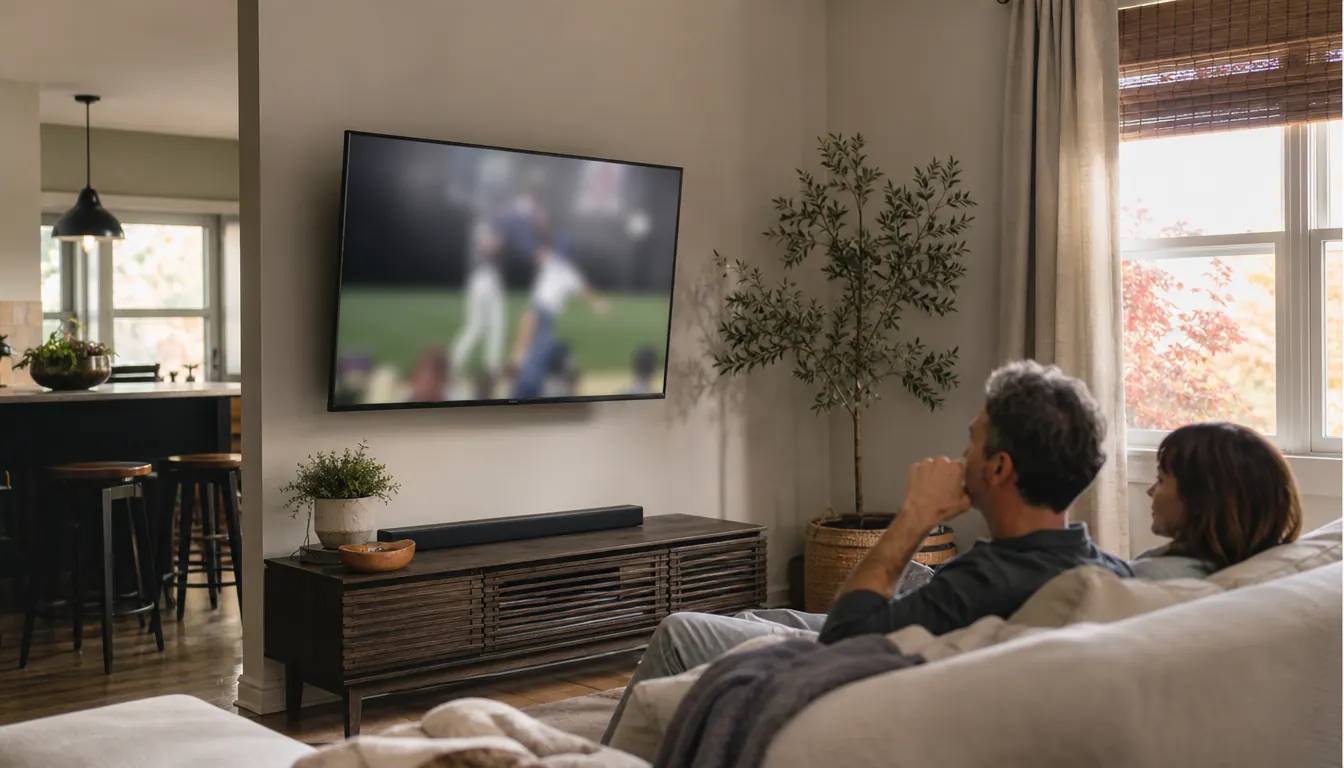
There is a version of this review where the living room is tidy, the TV is pulled out at a handsome angle, and everything went according to the plan on the box. This is not that version. I bought the Mounting Dream full motion mount in November 2025, the same week the 55 inch TCL came through the door, and I hung it myself on the long wall of our living room with Marcus holding the heavy end. It has been up ever since, holding that set about 11 feet from the couch. It has done its job, and it has also taught me a handful of things I would rather have known before I marked the wall. Those are what this page is about.
I am 58, retired out of the city bus garage, and I have hung exactly one television bracket in my life, this one. So treat what follows as the notes of a careful amateur, not a professional installer. What I can tell you honestly is how this thing behaved in a real single story house in Raleigh, with a real 55 inch set, a wife who watches the six o'clock news while she is cooking, and a grown son who shows up on Sundays expecting a clear picture on a kickoff return.
The Quick Verdict
Stout metal, six articulating arms, and a tilt range that handles afternoon glare without a fight. The honest catches are the depth it adds behind the set, a listing that contradicts itself on maximum screen size, and a swivel figure nobody publishes.
Amazon Check Today's Price →The specs that actually decide this purchase are buried halfway down the page
Maximum screen size, tilt range, VESA pattern and the leveling adjustment all live in the product description. Read them against your own set before you drill, not after.
Amazon Check Today's Price on Amazon →What the Listing Says, and What It Leaves Out
The title reads 32 to 70 inches and up to 110 pounds. Scroll to the attribute table on that same page and the maximum supported screen size says 65 inches. Both numbers sit on the same listing and nobody there explains the gap between them. My guess is that 65 is the cautious ceiling for a set that hangs well off the wall and 70 is the outer edge for one that stays folded, but that is a guess and you should treat it like one. My TCL is 55 inches, comfortably inside either figure, so the contradiction cost me nothing. If you own a 70 inch set it might cost you something, and you deserve to hear that from a person rather than a spec table.
The rest of the numbers are plainer. The wall plate takes a maximum VESA of 400 by 400 millimeters, which is 16 by 16 inches of bolt holes. Six articulating arms carry the set. The enclosure is metal. It tilts up 5 degrees and down 15. There is a plus or minus 3 degree leveling adjustment you can use after the bracket is already bolted to the wall, and the warranty runs for life. All of that matched what came out of the box, which is not a thing I get to say every time I buy something online.
What the listing will not give you is the swivel figure. It says the mount swivels left and right, which is true, and then it stops talking. For a full motion bracket that is the one number a buyer actually wants, because swivel is the entire reason to choose arms over a flat plate. There are close to 98,000 ratings on this bracket and I still could not find the figure in the listing text. I can tell you what it does in my room, and I will, but understand that I am reporting from one couch in one house.
The Install, Honestly
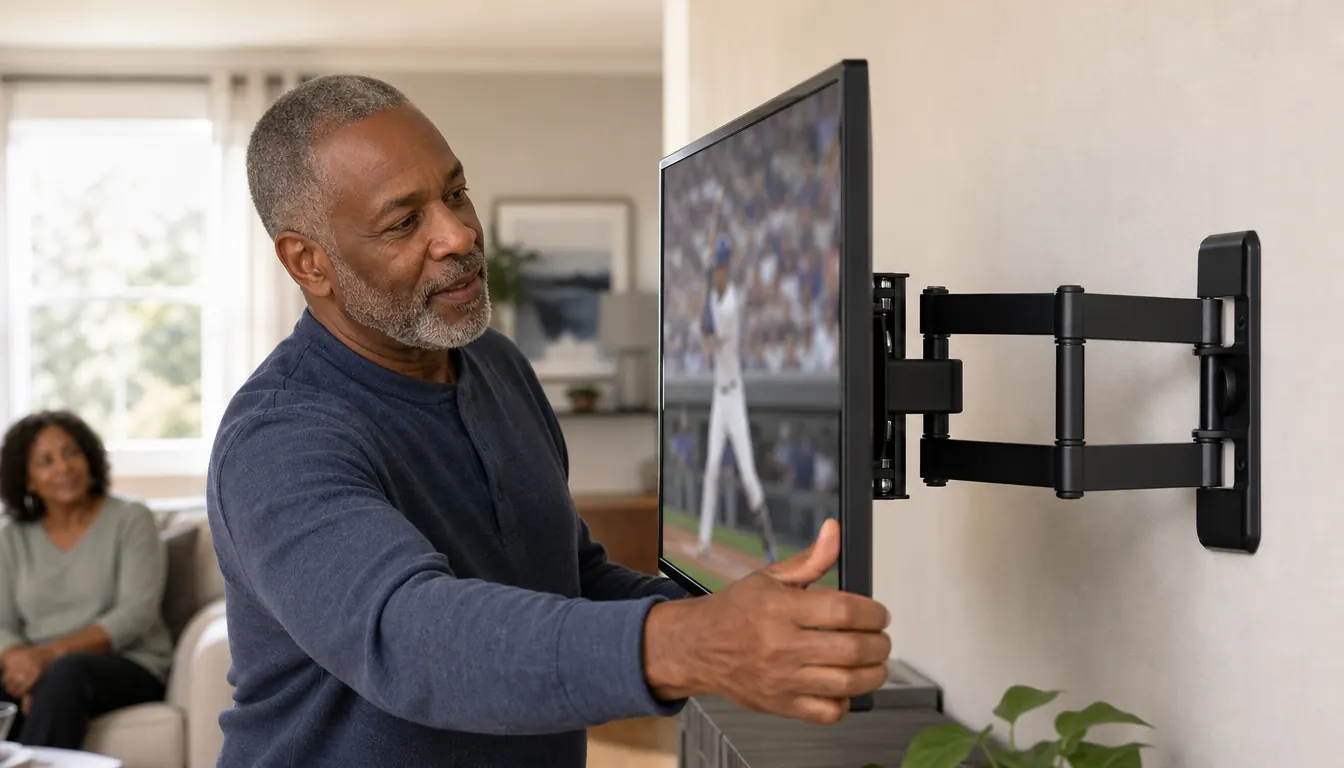
This bracket wants two studs. On my long wall there were two where I needed them, and that decided the whole layout. I found them, marked them, drilled, and bolted the plate up. The hardware came in pre labeled bags, which sounds like a small courtesy until you have done a job where every bolt lives in one sack and the instructions are a photograph of a photograph. The printed instructions were clear enough that I never had to guess, and I read them twice anyway, because I only get one shot at a wall in my own living room.
Hanging the television is a two person job at 55 inches. Marcus took one end and I took the other, we lined the bolt holes in the back of the set up with the bracket, and we drove the bolts home. Then I checked level, found it a hair off, and used the plus or minus 3 degree adjustment to bring it true with the TV already hanging on the wall. That adjustment is the difference between a two minute fix and taking the whole set down to drill again. Of everything on this bracket, it is the feature I would miss most if it were gone.
The part that took the longest was not the drilling. It was the arms. Six articulating arms means several joints that all have to move freely without slop, and I worked each one through its range before the set went up, mostly out of curiosity. They moved clean straight out of the box and they have stayed that way. The other time sink was height. A swing arm lets you change the angle later, but it does not let you change the height without moving the plate, so decide where the middle of the screen should sit and then commit. Ten minutes on the couch with a tape measure and a strip of painter's tape saved me a redo.
Start to finish, with a break for lunch and a run to the hardware store for a bit I already owned and could not find, it was an afternoon. Two people who read the instructions first and own a stud finder would do it faster. Nobody needs a professional for this, but nobody should do it alone with a set this size either.
The Part Nobody Warns You About: Depth
A full motion bracket holds the television out from the wall. The arms fold, they do not disappear. If your old set sat on a stand pushed back into a corner, this will look different, because the screen now hangs off the wall by the thickness of the folded arms no matter what position you leave it in. Measure that before you drill. On my wall it made no difference at all, but if a doorway, a curtain rod or a shelf sits just to the side of where the TV goes, it might matter more than you expect.
The other half of that trade is access. The ports on the back of a modern set sit close to the panel, and once the TV is on the arms and pushed flat, reaching them means pulling the set back out first. I ran the HDMI cable that feeds the soundbar and the coax from the antenna before the television went up on the plate. If I had waited, I would have been doing it by feel with my cheek against the wall. Plan the cables early. It is the least interesting advice on this page and the one I would repeat loudest.
How I've Used It: News at Six and Sunday Football
Here is what the swivel does in my house. Gloria watches the evening news while she finishes up in the kitchen, and I pull the set out and angle it toward that side of the room. It moves with one hand on the edge of the television and it stays where I leave it instead of drifting back on its own. When the game comes on, I push it flat against the wall and the room goes back to looking like a room instead of a sports bar. That swing is the whole reason I bought a full motion bracket instead of a fixed one, and it works well enough that I stopped thinking about it months ago.
The tilt matters more than I expected. Our couch sits lower than the screen and the afternoon sun comes in from the window side. Tipping the set down takes the glare off the glass without me shoving a pillow under the front of anything. I have used maybe half of the 15 degrees available. The 5 degrees up I have used exactly never, but it is there if you hang the TV higher than I did, and plenty of people do.
Stability is the thing I would want to know if I were reading this instead of writing it. With the arms folded against the wall, that 55 inch set does not move. No wobble when Marcus flops back on the couch, no shimmy when the washer is running. Pulled out toward the kitchen there is a bit more give to it, which is what a lever does, and it does not worry me because nobody in this house is body checking the television. If you have small children or a dog with a tail at screen height, leave it folded.
One honest wrinkle that has nothing to do with the bracket and everything to do with a room. The soundbar sits on the media console under the TV and the TV swings, so when I angle the screen toward the kitchen the sound stays where the bar is. For news at six that is fine, the bar is wide and Gloria is not far off axis. For a game I put the screen back flat anyway. But if you plan to watch a lot of movies with the screen turned, know that your sound does not turn with it.
How It Has Held Up
The bracket has been on the wall since that week in November 2025. Nothing has sagged, nothing has loosened, and the level I set the first day is still the level it sits at now. The joints I worked through before the TV went up still move the way they did then, with no rattle when I swing the set out. I go over the bolts about once a season with a wrench, not because anything moved but because it is a heavy object hanging over a couch and that is what a careful person does.
The metal has held up better than I expected for something that gets handled every day. I am not gentle with it. When I pull the screen toward the kitchen I grab the edge of the television, and the bracket takes that load every evening without complaint. The only wear I can point to is the dust along the top edge of the TV, which is a housekeeping problem and not a Mounting Dream problem.
If you are the type who reads reviews looking for the failure, here it is in plain language: after months of daily use, I have not found one. That is not the same as saying the bracket is perfect, because it is not, and the things I do not like are already on this page. It is saying that the hardware has done what it promised and I have no reason to take it back down.
What I Liked
- Metal frame and six articulating arms, steady with the screen folded to the wall
- Tilt of 5 degrees up and 15 down handles afternoon glare without a fight
- Plus or minus 3 degrees of leveling after it is hung, so a small miss is not a redo
- Hardware in pre labeled bags and instructions a homeowner can follow
- Swings far enough to aim the screen at the kitchen side of the room
- Lifetime warranty and close to 98,000 ratings behind it
Where It Falls Short
- The listing contradicts itself on maximum screen size, 70 inches in the title and 65 in the table
- Swivel range is not published anywhere on the product page
- The arms do not fold flat, so the set always hangs off the wall
- Hanging a 55 inch set takes two people
- Ports are hard to reach once the TV is on the plate
The listing gives you the tilt numbers, plus 5 and minus 15, and the plus or minus 3 for leveling. It never gives you the swivel, and swivel is the reason you are reading about a full motion bracket in the first place.
Who This Is For
This is for the one room house, the room where the couch, the kitchen and the front door all share a wall. If you watch the news while something is on the stove, or you move seats when the game gets tight, the swing arm earns the depth it adds. It is for anyone with two studs where the set needs to hang and a second person for the lift. It is also for someone who wants a metal bracket with six arms and a lifetime warranty from Mounting Dream, a brand with close to 98,000 ratings on this bracket alone, and who would rather read a careful amateur's notes than a marketing page.
Who Should Skip It
If the television goes up once and never moves, skip this and buy a fixed bracket. You will give up the swing and gain a lower profile against the wall, and you will never miss what you did not use. If you do not have two studs where the screen has to hang, this is not the bracket for you, and no clever hardware fixes that. If you want the set to sit flush like a framed picture, a full motion arm is the wrong tool entirely. And if the thought of lifting a 55 inch television with one other person makes your back ache, hire it done or leave the set on a stand.
The short version, after living with it: the Mounting Dream bracket does what the pictures promise, and it does it without drama. The things I would change are the things nobody lists, which are the depth behind the screen, an unexplained maximum size, and a swivel figure you have to guess at. Know those three going in and you will be happy with it.
One room, one screen, and a couch that is not always the right seat
Full motion arms, 5 degrees up and 15 down of tilt, and leveling you can still use after it is on the wall. Check the screen size range against your own set first, then read the rest.
Amazon Check Today's Price on Amazon →