
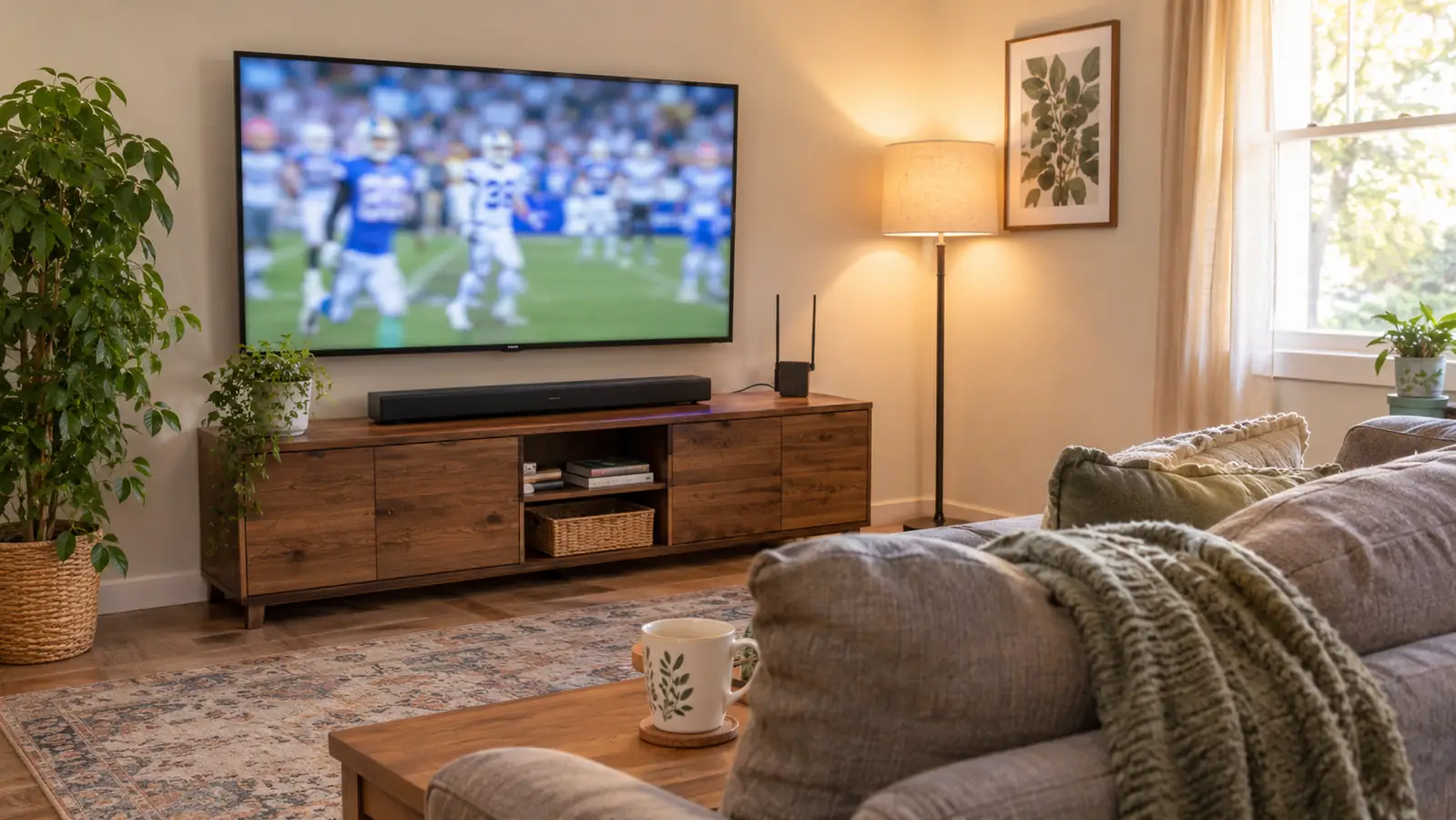
The thing nobody tells you about cancelling cable is that the local news does not come with it. Gloria and I had cable for about twenty years, and when we finally cut it in April 2025, the first thing that happened was that the six o'clock news disappeared. Not the national stuff. The local stuff. The weather guy who actually knows which part of Raleigh gets the afternoon storms, the school closings in January, the high school football scores on Friday night.
So a month later I bought an indoor TV antenna. The one I landed on is the intelbras indoor antenna for local channels, and it has been plugged into the back of our TV for about eighteen months now. It sits upright on the low media console under the TV, on the window side. It is not a piece of equipment I think about. That is the highest compliment I can pay a piece of hardware you buy once and then stop noticing. What I will tell you is what it does, what it does not do, and the one thing about it that genuinely annoyed me for a while.
The Quick Verdict
A small, quiet panel that brings in the local broadcast stations and then gets out of the way. Picture quality on football is genuinely good. Placement matters more than the listing admits, and you will move it two or three times before it settles.
Amazon Check Today's Price →The local channels came back the same afternoon I plugged this in
One cable into the TV, one spot on the console, and the six o'clock news was back. Eighteen months later it is still there and I still have not touched it.
Amazon Check Today's Price on Amazon →How I've Used It
Here is the honest inventory. We have one TV in this house that matters. A 55 inch TCL on the long wall of the living room, about eleven feet from the couch. The intelbras antenna plugs into the antenna input on the back of it and sits on the console below. That is the whole setup. There is no amplifier, no splitter, no second antenna in another room, no attic run, no outdoor mast, and no app to sign into. One cable, one input, and one scan for channels that I ran the afternoon it arrived, standing there with my coffee waiting for the progress bar to finish.
The routine has not changed in eighteen months. Weekday mornings, coffee, local morning news. Gloria watches the evening news at six while she is finishing up in the kitchen, which is why the TV gets pulled out on the mount and angled toward that side of the room. Saturday is college football. Sunday is NFL. In winter we add NBA and college basketball, and in summer there is the occasional baseball game on a Saturday afternoon. Every one of those comes through the antenna, not through a streaming app.
The first Saturday after I set it up was the test I actually cared about. I had the pregame on by noon, and I spent most of the first quarter walking up to the screen and then back to the couch, looking for the softness I was braced for. There was not much. The ticker at the bottom was crisp, the score bug was crisp, and the grass was grass. That was the moment I stopped wondering whether cancelling cable had been a mistake.
The switch itself is one button. I use the TCL remote only to get to the antenna input and then I put it back down. Everything else in this house runs through a Roku stick, and the difference matters: the Roku is for streaming, the antenna is for whatever is being broadcast live. Two different jobs, two different buttons, and after a couple of weeks your hand knows which is which without looking. Marcus figured it out in one Sunday visit, which tells you how steep the learning curve is.
I want to be clear about what this thing is not. It is not a cable replacement. It gives you the local broadcast stations, which in our area covers the major networks, and that is what we wanted. If you are expecting a channel for every mood you are in, you will be disappointed, and that is a you problem, not an antenna problem.
What the Specs Actually Mean in a Living Room
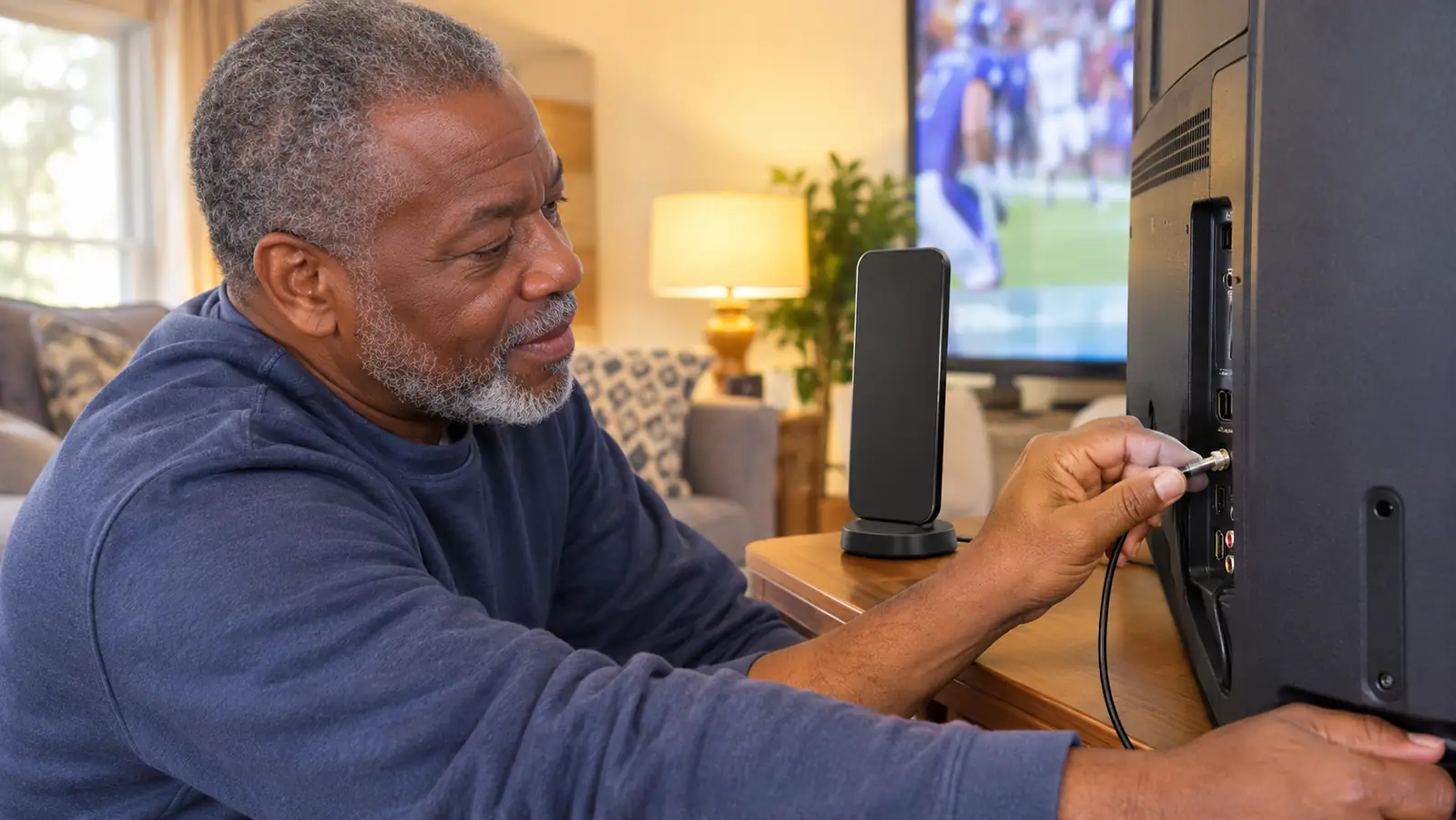
The listing says 4K and 1080p support, it says 75 ohm impedance, it says the cable runs 16.5 feet, and it gives the panel itself as about ten inches by seven and a half by twelve. I am going to translate those into living-room language, because spec sheets are written for people who already know what they mean.
The picture support is the easy one. Whatever the station is broadcasting, the antenna passes it along. On a Sunday afternoon football game, the difference between this and the compressed stream we used to watch is real and it is not subtle. Grass looks like grass instead of a green smear. The yard lines are crisp when the camera pans. On a kickoff return, when the camera whips to follow the returner, the motion holds together. That is the thing I notice most, because fast motion is where cheap video falls apart first. Same story on a fast break in a basketball game in February, when the whole camera swings the length of the court and the ball stays a ball instead of smearing into the hardwood.
The 16.5 foot cable is the spec that actually mattered most in my house. It is long enough that I could put the intelbras antenna on the window side of the console instead of right under the TV, and that extra few feet of separation made a visible difference in how steady the signal was. The listing treats the cable length as a convenience feature. For me it was the difference between a good spot and a bad one, and the difference between the antenna sitting in the open and being crammed behind a screen where it cannot hear anything.
The physical size is small enough to sit on a console and be forgotten. It is flat and lightweight, and the listing describes it as a soft flame-retardant material, which is a fancy way of saying it is a flat panel rather than a metal contraption with arms. It blends in. Nobody has ever walked into my living room and asked what the thing on the console is. Gloria dusts around it the same way she dusts around the soundbar, which is to say she notices it about once a month and then forgets it again.
Placement Is the Whole Ballgame
Here is where I earn my keep as the neighbor you call when the TV is acting up. The single biggest factor in how well this antenna works is not the antenna. It is where you put it. I moved mine three times in the first week, and the difference between the worst spot and the best spot was not subtle.
The worst spot was flat against the wall behind the TV, tucked completely out of sight. It looked great and it worked badly. The wall behind our TV is an interior wall, and putting the antenna directly against it, behind a screen, was basically asking it to hear through a mattress. If you have ever held a conversation through a closed door, you understand the physics. For about a day I thought we had bought the wrong thing, and I was already composing the review in my head.
The best spot, for us, is upright on the window side of the console, a couple of feet to the left of the TV itself and about eighteen inches forward of the wall, with nothing solid in front of it. That is where it has lived since about week two. The 16.5 foot cable is what makes that possible without a trip to the hardware store. If the cable had been three feet long, I would still be down there fiddling with it on a Saturday morning, and I would have blamed the intelbras unit for a problem that was really furniture.
One practical note. Moving it a few inches changes things. Not dramatically, but enough that if a station is coming in rough, try a different spot on the same console before you conclude the antenna is the problem. Put it in the open, get it away from the wall, and give it a clear path toward the window. This is the single most useful thing I can tell you, and it is not in the listing.
I moved it three times in the first week. The difference between the worst spot and the best spot was not subtle, and neither one cost me anything but ten minutes and a sore shoulder.
How It Has Held Up Over Eighteen Months
Nothing has failed. No cable has frayed, no connection has gone loose, nothing has needed to be re-seated or wiggled. It has sat in the same spot for a year and a half and done its job, which is exactly what you want from a piece of equipment you never think about. There is nothing to charge and nothing to restart.
The one recurring annoyance is weather. Not storms taking it out, nothing that dramatic. But on a heavy overcast day, or during a real downpour, a couple of the weaker stations get soft. Not gone, just soft, with a little pixelation in the corners during fast motion. We had a rainy Saturday in September when the early college game carried a faint shimmer along the bottom of the screen for most of the second quarter. It came back on its own, the way it always does. It has never once required me to get up and do anything, but if you are the kind of person who cannot tolerate a moment of breakup during a fourth quarter, you should know that broadcast television is not a guaranteed pipe and never has been.
The other thing worth saying: I did not have to think about the TV's built-in tuner, or a converter box, or any of that. It plugs into the antenna input, the TV scans for channels once, and that is the end of the setup. It took me about ten minutes total, most of which was getting behind a wall-mounted TV with a flashlight and figuring out which input was which while Marcus read the labels off to me over the phone.
How It Compares to What We Had Before
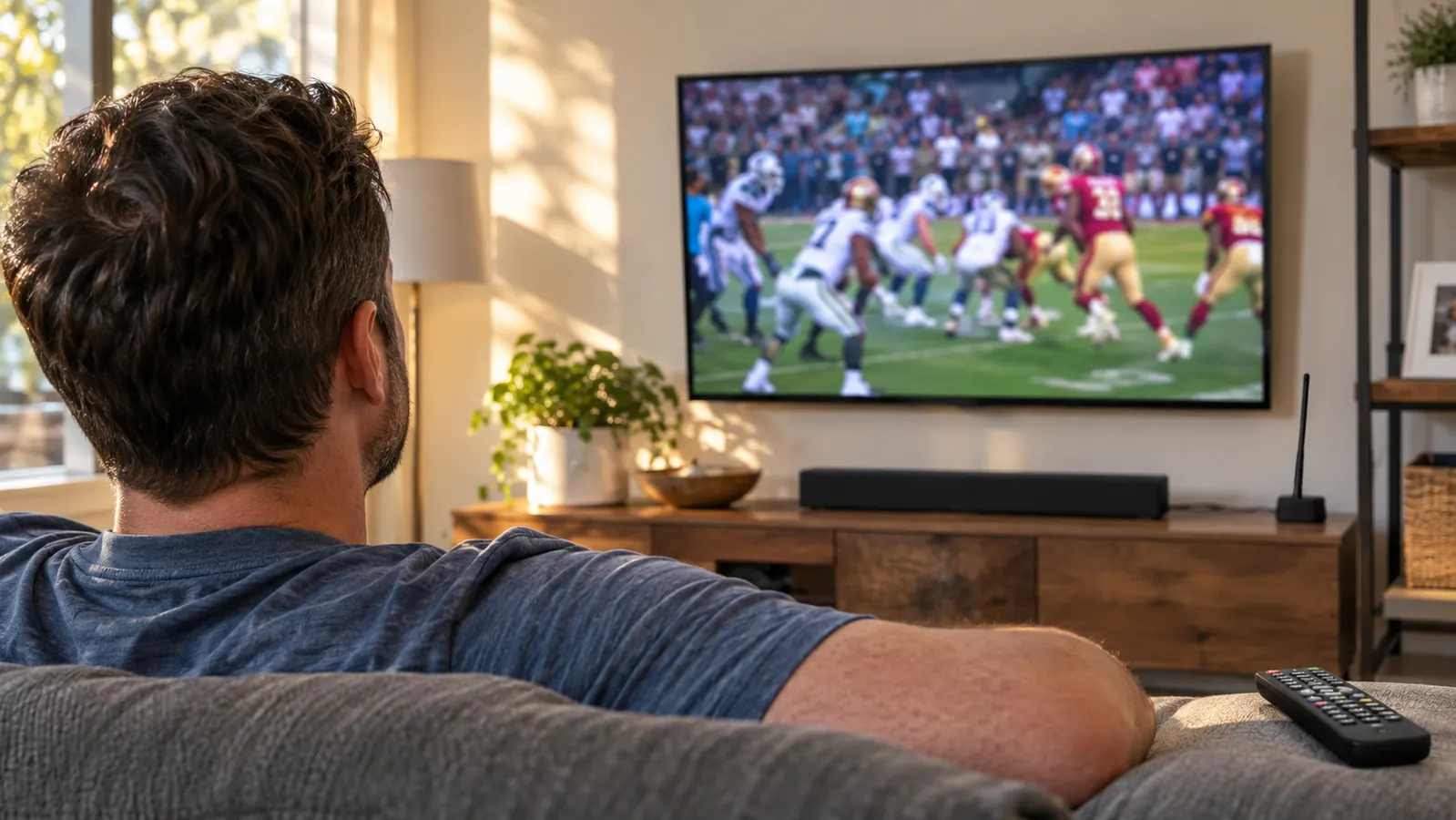
Before this, local channels came through cable. Twenty years of it. The picture through the intelbras antenna is better than the picture we had through cable on the same stations, which surprised me. Broadcast is not compressed the way cable and streaming are, and it shows, especially on sports.
Before we had the soundbar, we used the TV's own speakers, and that is a separate story, but it is related: the antenna gave us a better picture and made the thin TV's speaker problem more obvious, not less. Gloria could not hear the evening news dialogue without cranking the volume, and that is what finally got the soundbar onto the console in January 2026. So in a way the antenna started that whole chain of events.
And compared to streaming the local news through an app, the antenna wins on delay. Live is live. When the game is on, the antenna feed is ahead of the streaming feed, sometimes by a noticeable amount. If you have ever had a neighbor text you about a play before you saw it, you know why that matters.
What I Liked
- Local broadcast stations come in clean, and the picture on live sports is visibly better than compressed streaming
- The 16.5 foot cable gives you real placement options instead of forcing the antenna right under the TV
- Small, flat, and easy to hide on a console without looking like equipment
- Plug and play. One cable, one channel scan, done for eighteen months
- No subscription, no account, no app, no firmware update
Where It Falls Short
- Placement matters a lot, and the listing does not prepare you for that
- Weak stations get soft in heavy weather, especially during fast motion
- It only gets you broadcast stations, so it is not a cable replacement
- Out of the box it is easy to put in the worst possible spot and blame the hardware
Who This Is For
If you are a sports household that cut cable and misses the local broadcast games, this is the simplest fix there is. Sunday football, Saturday college football, the NBA in winter, a ballgame in July. All of it comes through, and the picture is better than what you were streaming.
It is also for the news watcher. If the morning news with coffee and the six o'clock news are part of your day and they vanished when you cancelled, an antenna brings them back for one payment, once, with nothing recurring attached. Gloria has not once asked me why the news is gone.
And it is for anyone who does not want another account. No login, no password, no app that updates itself and moves the buttons around. You plug it in and you own it.
Who Should Skip It
Skip it if what you actually want is cable back. If your viewing is mostly cable channels, a regional sports network, or anything that is not broadcast over the air in your area, this will not get you there and no indoor antenna will. Be honest with yourself about that before you buy.
Skip it if your house is in a spot where broadcast reception is genuinely poor. That is a location problem, not a product problem, and an indoor antenna on a console is not going to solve it. Check what stations actually reach your address before you spend anything.
And skip it if you are not willing to move it around for ten minutes. This is not a plug-in-and-forget device in the first week. It becomes one. But you have to earn that first week, and if you are the type to leave it wherever the box landed and then write an angry review, save yourself the trouble.
Eighteen months, one cable, and the local news still comes on at six
It sits on the console, it brings in the local stations, and I have not had to touch it since the second week. For a sports household that cut the cord, that is the whole review.
Amazon Check Today's Price on Amazon →